Design Versatility: Integrating the Monkey Icon from Home Animals Collection into Modern Visual Projects
The Strategic Value of Simple Line Elements in Digital Interfaces
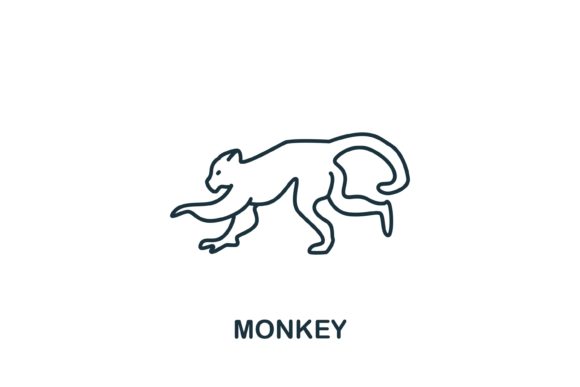
In the evolving landscape of user interface design and digital communication, clarity often supersedes complexity. The shift toward minimalism is not merely an aesthetic preference but a functional necessity for reducing cognitive load. When designers select assets like the Monkey Icon from Home Animals Collection, they are choosing a visual shorthand that communicates specific themes—playfulness, intelligence, or nature—without occupying excessive screen real estate. A simple line element monkey symbol serves as an anchor point in templates, web design, and infographics where space is at a premium. Unlike detailed illustrations that can become muddy when scaled down for mobile navigation bars or favicon usage, vector-based line art maintains its integrity across all resolutions.
This specific style of iconography bridges the gap between professional utility and organic warmth. In corporate environments, strictly geometric icons can sometimes feel sterile or impersonal. Introducing a stylized primate symbol adds a layer of approachability to educational platforms, wildlife conservation sites, or children’s product lines. The "home animals" categorization suggests a domesticated or accessible quality, distinguishing it from wilder, more aggressive jungle imagery. This nuance is critical for brands aiming to foster trust and familiarity. By utilizing clean strokes and negative space, these symbols integrate seamlessly into diverse color schemes and background textures, ensuring that the visual hierarchy remains balanced regardless of the surrounding content.
Technical Specifications and File Format Advantages
Understanding the technical delivery of graphic assets is essential for efficient workflow management. When acquiring the Monkey icon from home animals collection, users receive both EPS and JPG files, each serving distinct purposes in the production pipeline. The inclusion of an EPS (Encapsulated PostScript) file is the primary advantage for professional designers. As a vector format, EPS allows for infinite scalability without pixelation. This means the same asset used in a small sidebar widget can be blown up for a large-format trade show banner or vehicle wrap with zero loss in quality. Furthermore, vector paths are mathematically defined, allowing for precise editing of stroke width, curvature, and color values within software like Adobe Illustrator or CorelDRAW.
Conversely, the provided JPG file offers immediate compatibility for non-designers or rapid prototyping. While raster formats lack scalability, they are universally supported across word processors, presentation software, and basic image viewers. For a teacher creating a classroom handout or a business owner drafting an internal memo, the JPG eliminates the need for specialized vector software. However, professionals should note that while JPGs are convenient, they do not support transparency. For web design and overlay applications, converting the EPS to a PNG or SVG format is often a necessary intermediate step to preserve the transparent background inherent in the original line art. This dual-file delivery system ensures that the asset is "easy to edit and use" across the entire spectrum of technical proficiency, from hobbyists to senior art directors.
Editing Vector Assets for Custom Brand Alignment
The true power of a logo vector graphic lies in its malleability. A static image locks you into a single interpretation, whereas a vector file invites customization. When working with the simple line element monkey symbol, designers can adjust the stroke weight to match existing brand typography. If a website uses thin, elegant serif fonts, thickening the icon's lines might create visual dissonance; refining the path to a hairline weight creates harmony. Additionally, open vectors allow for the modification of facial expressions or posture. A slight adjustment to the curve of a mouth or the tilt of a head can shift the tone from curious to cheerful, aligning the mascot more closely with specific campaign messaging. This level of control transforms a generic stock asset into a bespoke brand element.
Practical Applications Across Diverse Industries
The utility of this icon extends far beyond generic decoration. Its semantic associations make it particularly valuable in several key sectors:
- Educational Technology: Primate imagery is cognitively linked to learning, problem-solving, and curiosity. EdTech platforms frequently utilize monkey symbols to denote interactive modules, gamified achievements, or biology curriculum sections. The friendly line-art style prevents the imagery from appearing too juvenile for adult learners while remaining engaging for younger students.
- Wildlife Conservation and Non-Profits: Organizations focused on habitat preservation require visuals that evoke empathy without being overly graphic. A minimalist symbol acts as a respectful representation of species diversity in annual reports, donation buttons, and awareness infographics. It conveys the subject matter instantly, allowing text to focus on statistics and calls to action.
- Pet Care and Veterinary Services: While monkeys are not traditional domestic pets, the "Home Animals Collection" framing positions this icon within a broader category of animal care. Exotic pet veterinarians, sanctuaries, or zoological educational programs can use this symbol to categorize specialized services or informational resources distinct from standard cat and dog care.
- Creative Marketplaces and Print-on-Demand: Designers creating sticker packs, t-shirt graphics, or planner stickers rely on clean line art that translates well to cutting machines and screen printing. The simplicity of the vector paths reduces production errors and ink usage, making it a cost-effective choice for merchandise.
Visual Hierarchy and Composition in Infographics
Infographics demand a rigorous adherence to visual flow, and the monkey icon functions as an effective directional or categorical marker. In complex data visualization, consistent iconography helps users parse information quickly. When using the Monkey Icon from Home Animals Collection alongside other symbols from the same set, designers ensure stylistic consistency—a common pitfall when mixing assets from different sources. Consistent line weights, corner radii, and optical sizing create a cohesive narrative thread throughout the graphic.
Consider an infographic detailing primate social structures or evolutionary biology. Using a realistic photograph for every data point would result in visual clutter and slow loading times. A simple line symbol acts as a bullet point with personality, breaking up dense text blocks and guiding the eye down the page. The symbol can also be repurposed as a watermark or background texture at low opacity, adding thematic depth without competing with foreground data. This versatility makes the asset a workhorse for information designers who need to balance aesthetic appeal with data density.
Accessibility and Semantic Considerations
When implementing any icon in web design, accessibility must be a priority. Simple line elements generally perform well for users with visual impairments because of their high contrast and distinct silhouettes. However, designers must ensure that the monkey symbol meets WCAG contrast ratios against its background. Because line art relies on negative space, testing the icon at various sizes is crucial to ensure it remains recognizable when resized by browser zoom tools. Furthermore, when used functionally (e.g., as a link to a "Primates" section), the icon must be accompanied by appropriate alt text or ARIA labels. Decorative uses should be marked as such to prevent screen readers from announcing irrelevant information. Proper implementation ensures that the visual charm of the icon does not come at the expense of inclusivity.
Licensing and Commercial Usage Best Practices
Acquiring vector graphics involves understanding usage rights to avoid legal complications. Assets described as "easy to edit and use" typically imply a royalty-free or commercial license, but users should always verify the specific terms attached to the Monkey icon from home animals collection. Professional usage requires diligence regarding trademarking; while you can use the icon in your designs, you generally cannot trademark the unaltered stock vector itself. Modification is often required to claim unique ownership of a derived logo. Additionally, businesses should maintain organized asset libraries. Keeping the original EPS master file separate from exported derivatives ensures that future rebranding efforts or format changes can be handled efficiently without needing to repurchase or recreate the source artwork.
The integration of thematic iconography like the monkey symbol represents a micro-decision with macro-level impact on project cohesion. Whether serving as a navigational aid in a complex app, a branding element for an educational startup, or a decorative flourish in print media, the value lies in its adaptability. By leveraging the technical benefits of vector formats and understanding the psychological implications of simple line art, creators can maximize the return on investment for these digital assets. The combination of aesthetic flexibility, technical robustness, and broad applicability makes this specific collection a reliable resource for modern visual communication challenges.